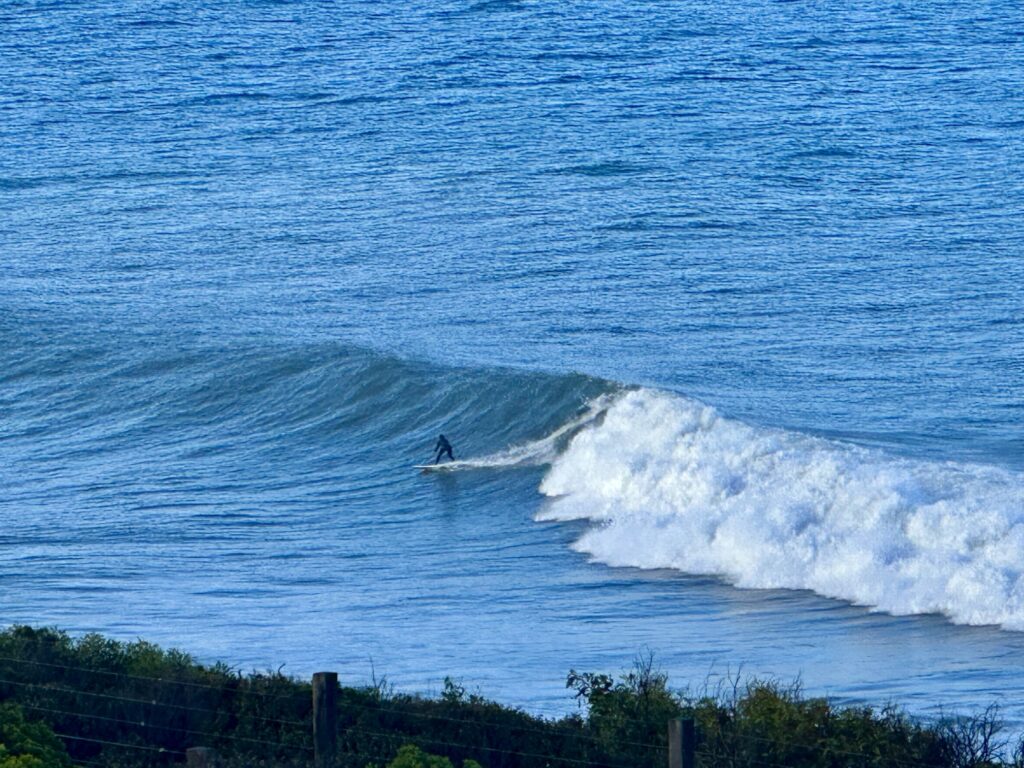
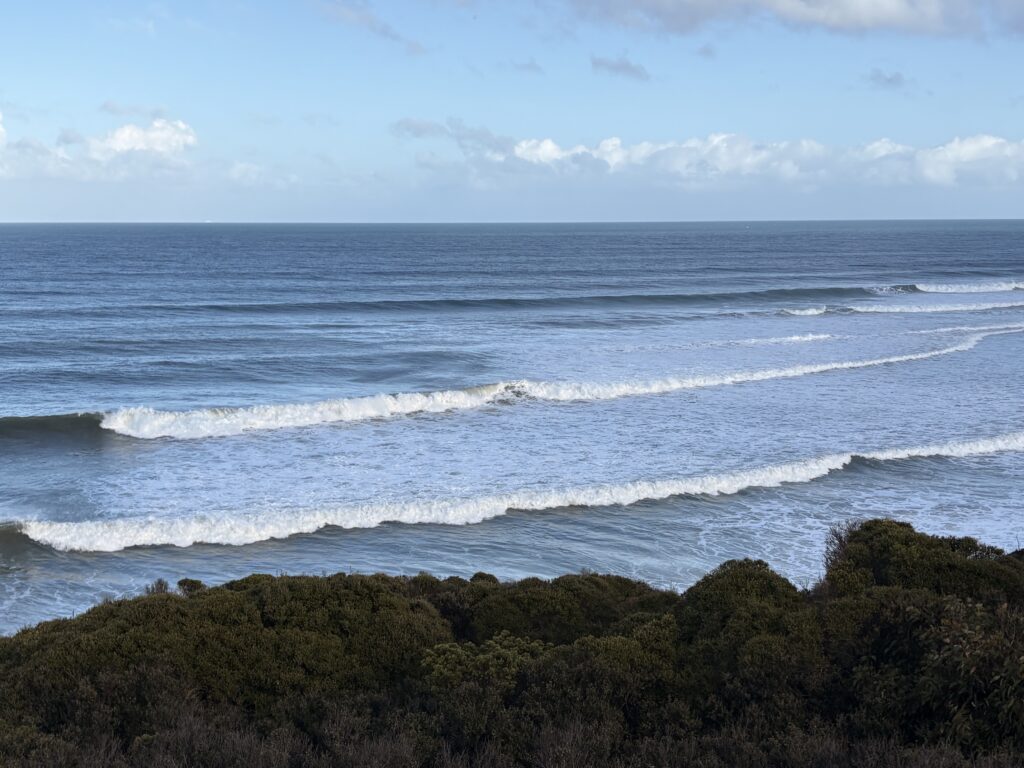
A beach holiday in winter is a special joy. Just five nights of bracing, salty wind, gazing out to the horizon and admiring the hardy souls out on their boards is real renewal. We have had mini breaks mainly in the east, closer to home, but decided to brave it to the west side of the bay and hit the surf coast. We chose Bells Beach for our stay, feeling that as a world-renowned venue for surfing competitions, there must be some waves to watch. We would explore the Surf Coast in low season!
As always, the further we get from home, the more we relax into uninterrupted conversations and comfortable silences with a background of ABC FM classic. Going east, we are usually in the country within minutes. This western adventure was more challenging, with a route taking us an hour to the CBD and then out the other side.
The first decision, and a good one, was to choose ‘No tolls’ in Google maps. It only added a few minutes and saved us $37 on the return trip – that’s a fish and chips meal! More than that, it took us through suburbs we don’t always see, including a lovely drive by Albert Park Lake before we finally hit the freeways. The western side is now an incredible new labyrinth of roads, and by the time we reached the services at the start of the towering Westgate Bridge, we needed lunch. It was my first experience of a Pieface purchase – actually a very nice pie with free sauce (it’s funny how a small sachet of tomato sauce felt so generous).
Bypassing Geelong reminded me of our frequent trips in my childhood to see family there. It was a different drive then that went right through Werribee with its famous stinky smell (we would see how long we could hold our breath), and then the long approach through Corio industrial area. On the way home, we would buy chips (couldn’t afford fish for eight people) and make them last all the way home. This time, however, we sailed around the edge at 100kph, gazing at the new developments on the fringes.
With all that was happening before and during a spring road trip up the coast last year in 2025, I did not manage to capture the highlights, nor even the lowlights, in my blog diary. The memory has blurred a little since 2025, but the feelings and photos remain with me and need to be written about before too much more post-trip time elapses. Some already has, of course, and will colour the memories, but that’s true of all of life’s retrospectivity.
The click of the front gate, the closing of the car boot, the last look around to make sure we were not doing any serious senior forgetting (a daily occurrence). Water bottles, Google maps and audiobooks loaded as we backed out of the driveway and pointed the trusty Mazda to the northern sun.
We had Levi’s squishy pig on board and he promised to send home photos of his exploits to our grandson.
A driving holiday is so much easier than flying to Europe as we have so many times and involves much less adrenaline. No panic about negotiating freeways in time to the airport, no fear of forgetting passports and documents, nor worry about booking details and weighing of luggage. I am fortunate or mad enough to have done seven trips to Europe and not having to steel myself for a long haul flight suddenly felt deliciously refreshing even before we turned out of our street. This was the great Aussie road trip!
Unlike the claustrophobic panic I feel when the exit doors are closed on a plane, I knew that I could stop the car and get out any time I wanted to. Peter had polished said car so that its ‘crystal soul’ red duco gleamed and was rearing to go. We were off and running!
We planned to head east, then north, over the border, hugging the coast, taking three days to get to Jervis Bay; then to take the trip back slowly.
I love country motels, with their beige decor and unpainted brick interiors. Often there is still a flap in the door where they used to insert an ordered breakfast. Once on the road it is all we need, and helps us to focus down and leave complex life demands behind.
Orbost was far enough from home for our first motel stay and by the time we were ready to find dinner, the main street was very quiet. Undaunted by the bad experiences we have sometimes had at Chinese takeaways in country towns, we were ever hopeful, and found Leon Palace, an Asian place where we were almost the only customers – should we have been worried?
Before we knew it, we were conversing in Indonesian with the surprised and friendly female cook from Timor and enjoying great food. In just a few hours, I already felt liberated from cooking and the unwinding had begun. We slept so well – far enough back from the main road not to hear the trucks thundering all night.
Although haiku has changed with modern times, it originated in Japan in the 17th century as a reaction to the elaborate poetry of the time.
Classic haiku is written with seventeen syllables in a 5-7-5 pattern, which means that every word is important. It was usually connected to a season (known as a kigo) or a little moment that evokes an emotional response. It aims to ‘express much and suggest more’ and features simplicity, intensity and directness – a bit like a bonsai in words. Focusing on nature, these short form poems aim to include a kireji, or ‘cutting word’ that is an invitation to be surprised or to reflect.
Peter’s latest exhibition, Bella Italia, was held at the Oak Hill Gallery in Mornington, Victoria, in February 2025. It beautifully captured the memories of our incredible trip to Italy in 2023, visiting Sicily and Tuscany. (You can see my travel blog from then https://jeanettewoods.com/2023/08/ready-set-fly-europe-23-1/#more-739). His images inspired me to write for each painting, and, for the first time, we exhibited together: a fusion of paint and words, Italy and Japan! Those who visited the exhibition felt that the combination of each oil painting with a 17 word poem evoked new multi-faceted perspectives to the experience. These are some of the pieces from the exhibition. (Some are still available for sale. If you are interested, contact Peter for a catalogue at petersbwoods@gmail.com)
Human nature has been sold short. Humans have a higher nature which includes the need for meaningful work, for responsibility, for creativeness, for being fair and just, for doing what is worthwhile and for preferring to do it well. (Abraham Maslow)
My current writing commission has taken me into the world of work and welfare, and it has been quite a dive into the deep end. Westgate Community Initiatives Group (WCIG) has 38 years of history, and as it looks to future directions, wants to capture its origins: how does its DNA from the past shape and inform its current form and vision?
With a change of leadership, and emerging from the challenges of Covid-19, WCIG is searching for its stories. ‘Strategy story’ is a well-known business tool for exploring the past to inform the future, and that is the essence of my commission. As part of the project, WCIG wants a book written that will capture the origins of the organisation, trace its history and developments and highlight the values that have remained over the years that drive it today. Just a small project!
WCIG is a community-based, not-for-profit organisation committed to improving lives through practical responses to unemployment and disadvantage, and is one of many employment services competing for government contracts and partnerships that will provide openings for people who find it hard to get a job. There are all sorts of reasons for this: health, discontinued employment experience, lack of qualifications, mental challenges, physical disabilities, language challenges and age and many more. These factors all make it more difficult to find meaningful jobs.
Our little coastal town of Hastings is not known for its cultural events. A pleasant marina and a mangrove board walk around the bay are its main attractions. It has three supermarkets and a Kmart, a fast-food intersection that is always busy, a selection of cafes and restaurants, multiple fish and chip shops and countless massage shops and nail salons. What more could we want? It’s actually what I like about this little resort town on the side of the Peninsula that is often forgotten. No impossible crowds in summer; always a parking spot in the main street.
But an occasional performance or art show is very welcome for the culture-starved residents who have carved out a niche in this gentle area – sometimes described beautifully and accurately in Garry Disher’s crime novels.
So when a Writers’ Club mate toured the Peninsula directing an Oscar Wilde play and ended in Hastings, I had to go – for myself and for Jonty. Besides, it was a three minute drive down the street! I also took my granddaughter, who had never been to live theatre before. With memories of ‘The Importance of Being Earnest’, I expected this play to be a humorous satire. It turned out to be darker.
‘Lady Windermere’s Fan is a comedy of manners by Osca Wilde, set in the 1890s in London. The play revolves around Lady Windermere’s jealousy over her husband’s apparent interest in Mrs Erlynne, a mysterious older woman. When rumours surface about Lord Windermere’s payments to Mrs Erlynne, Lady Windermere confronts him, leading to a complex web of secrets, morality and second chances.
The Hastings Hall is a surprisingly pleasant venue. In the chilly burst of near freezing temperatures we were experiencing, I was grateful to feel a warm glow from the heaters as we entered. The stage was empty! Chairs had been set up in the round in the main part of the hall, with a floor rug and furniture in the centre. With my husband, granddaughter and a friend, we settled in for what was quite a long performance.
My initial impression was that I felt involved in the action as the characters entered the corner right next to me and I pulled my feet in out of the way. They made great use of the space, using all four corners and sides with impressive movement and choreography. In the party scenes, we felt present at the event, mixing with the colourful characters. Some had very resonant voices and commanded the whole space; others like Mrs Erlynne, had quieter voices that were absorbed into the high ceiling, but made me lean in to keep up with the story.
The characters were so well cast and provided what humour the play has. An intimidating Lord Darlington, both by size and voice; a flittery Agatha with her constant ‘Yes, Mama’; the ever-present clown figure of a contemporary style Parker, the servant. The famous fan was there from the beginning and seemed to symbolise the way the feelings and understandings (or misunderstandings) moved around each scene, depending on who had the feathery, fluffy fan.
I was impressed with the extensive memory work that Lady Windermere had done to be across all her lines for the whole two and a half hours; she must be exhausted after each performance from speaking, shouting and crying as the dramas of suspected infidelity unfolded. Plays have a history of contrivance driving plot and this play is no exception. The audience was groaning with anticipation until the secret was revealed, as we had known it for a while. I think that is how playwrights draw us in, as we know more than the characters and identify like somewhat omniscient narrators.
Lord Windermere was impressively huffy and ingenuous, and I felt I wanted to shake him and sort out the whole misunderstanding. He valiantly bore the aspersions cast on his character as a gallant, chauvinistic, old world, aristocratic male would.
As for the mischievous Duchess of Berwick – there is always a troublemaker like her somewhere, played so convincingly in this performance.
After the long build up of misunderstandings and flip-flopping of emotions and trust, the play ended suddenly without full resolution, and as my granddaughter commented, raised a number of questions about morality. Who is good and who is bad? And is anyone bad capable of doing good or vice versa? Like all well-crafted plays, this one is about human nature and its foibles, played out in the most intimate of relationships.
It tackles the ambiguity of morality and the slipperiness of language, both of which undermine trust. It is a satire that deals with hypocrisy, shallowness and a rigid society which forces gender roles. Perhaps the context has changed but there are some universal truths in the play, along with warnings about making judgements and taking things and people at face value. It causes the audience to take a vow against shallowness and presumption, and to live for authenticity, loyalty and mutual understanding. The writer in me began to toss around some thoughts about how to write a play, which is the challenging form of writing completely in dialogue.
Well done Morning Peninsula Theatre Company and Director Jonty Reason. Please come back to Hastings soon!
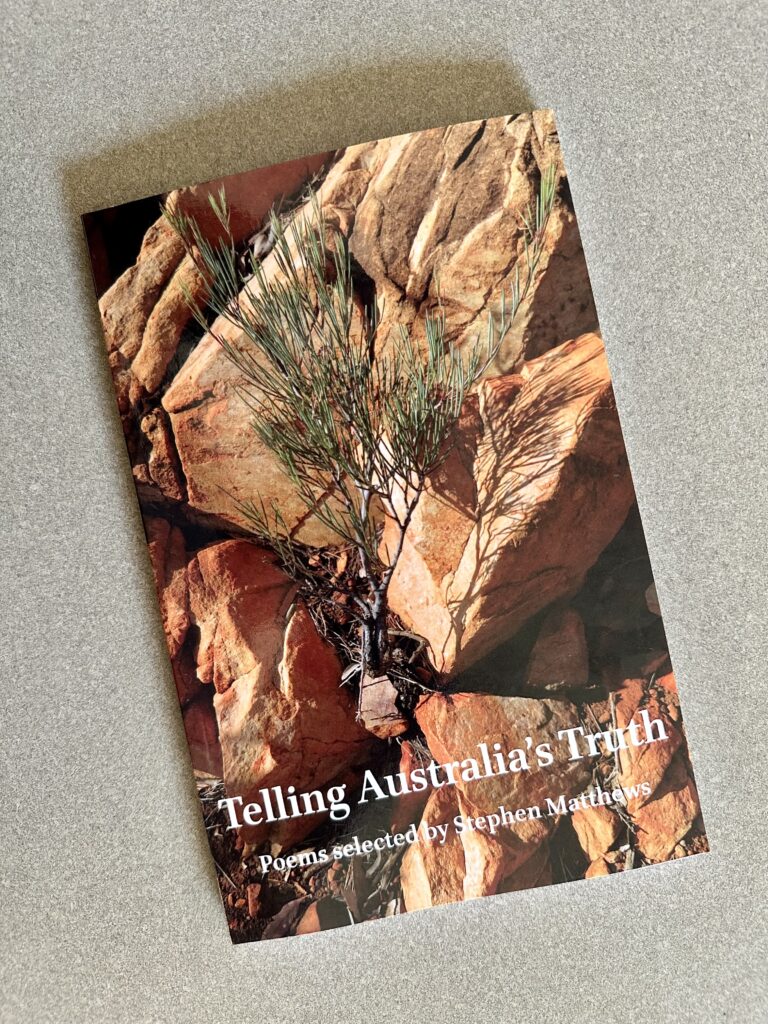
It’s an honour to have a poem selected for this anthology, hot off the press from Ginninderra Press (the publisher of ‘A Voice for Veronica’).
This collection had its beginnings in the shame, sadness and disbelief that was felt by so many after the result of the Voice referendum in 2023. The poems passionately express those reactions and unflinchingly explore some of the truths about Australia and its history, that, if they had been widely known, might have led to a different result. It is hoped that the readers will find solace, inspiration and hope in the pages that follow. Stephen Matthews, editor.
My poem, ‘Four Generations’, reflects my perspective on generational legacy and where I sit in history. I leave my beautiful and very smart grandchildren a mix of hope and sadness.
Four Generations
You were my gentle grandad
I was spoilt and loved, the first female of your line
Quietly spoken grower of delicate gladioli
You named one after me
Companioned by your loyal springer spaniel
But never told me about Fromelles
The horror of your war
Just grew sweet strawberries.
You were my upright father
Brilliant but Depression deprived
Lived for service and duty
Pressured night study late in life broke your health
I think you loved me.
I am still living and loved; married
Have played, planted and bought houses
Studied, travelled, written books and made music
Flourished in my female way
Gathered my grandchildren around me
Some say I am a lucky boomer.
Dear granddaughter, finished school, finding your way