
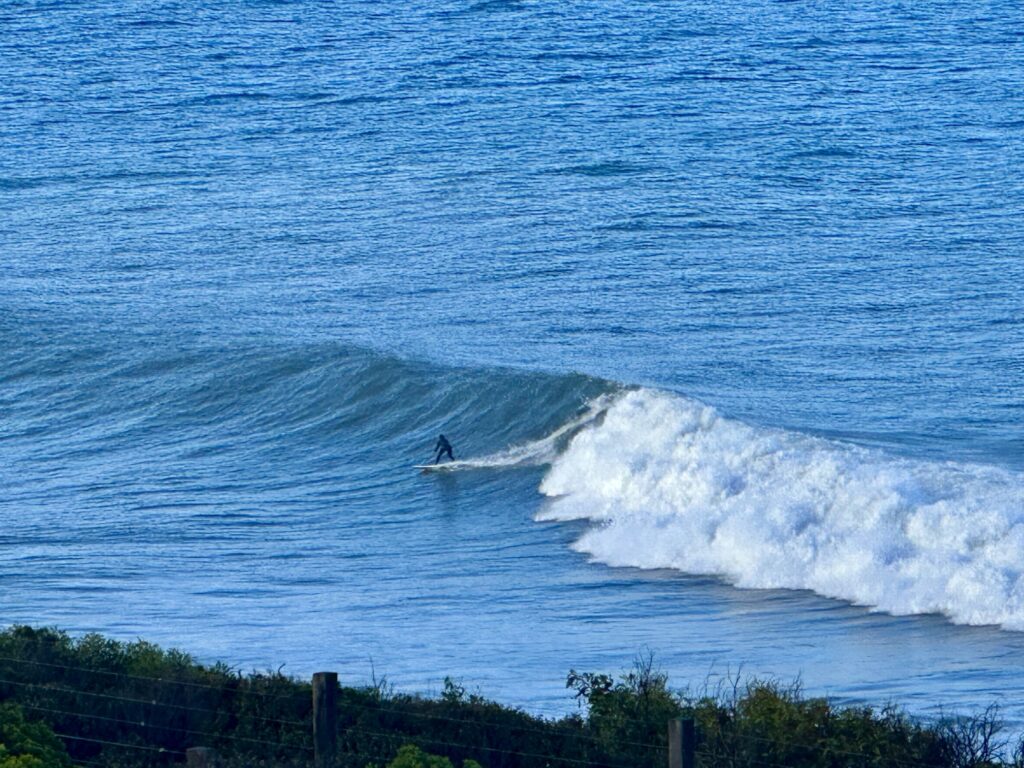
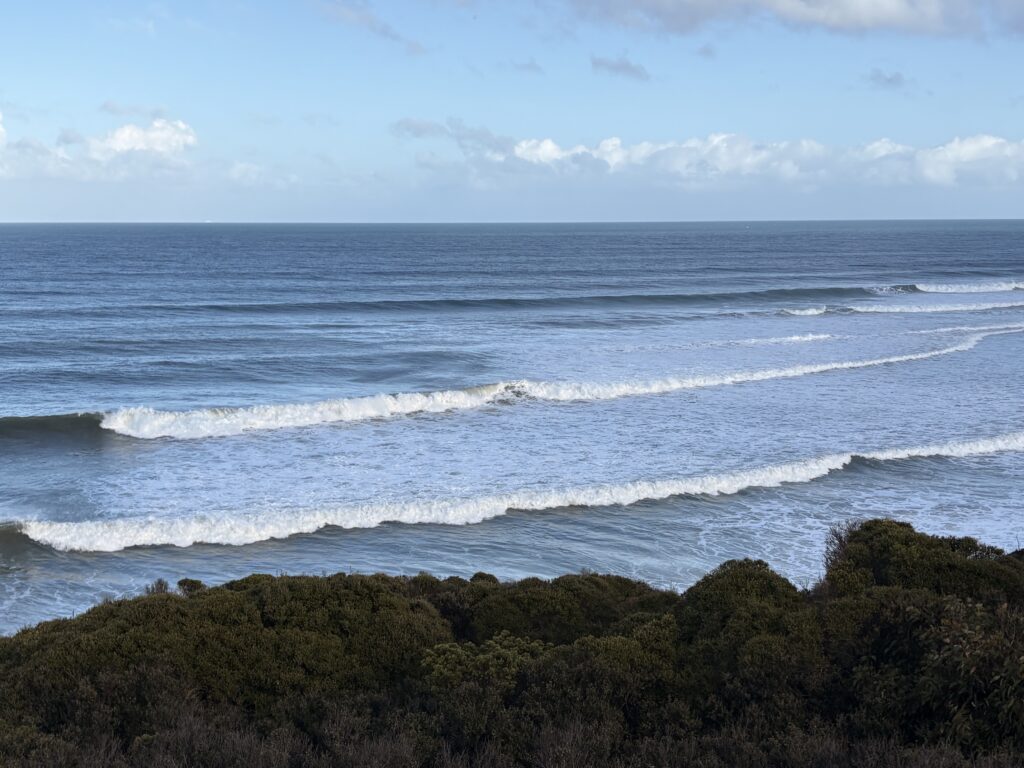
A beach holiday in winter is a special joy. Just five nights of bracing, salty wind, gazing out to the horizon and admiring the hardy souls out on their boards is real renewal. We have had mini breaks mainly in the east, closer to home, but decided to brave it to the west side of the bay and hit the surf coast. We chose Bells Beach for our stay, feeling that as a world-renowned venue for surfing competitions, there must be some waves to watch. We would explore the Surf Coast in low season!
As always, the further we get from home, the more we relax into uninterrupted conversations and comfortable silences with a background of ABC FM classic. Going east, we are usually in the country within minutes. This western adventure was more challenging, with a route taking us an hour to the CBD and then out the other side.
The first decision, and a good one, was to choose ‘No tolls’ in Google maps. It only added a few minutes and saved us $37 on the return trip – that’s a fish and chips meal! More than that, it took us through suburbs we don’t always see, including a lovely drive by Albert Park Lake before we finally hit the freeways. The western side is now an incredible new labyrinth of roads, and by the time we reached the services at the start of the towering Westgate Bridge, we needed lunch. It was my first experience of a Pieface purchase – actually a very nice pie with free sauce (it’s funny how a small sachet of tomato sauce felt so generous).
Bypassing Geelong reminded me of our frequent trips in my childhood to see family there. It was a different drive then that went right through Werribee with its famous stinky smell (we would see how long we could hold our breath), and then the long approach through Corio industrial area. On the way home, we would buy chips (couldn’t afford fish for eight people) and make them last all the way home. This time, however, we sailed around the edge at 100kph, gazing at the new developments on the fringes.
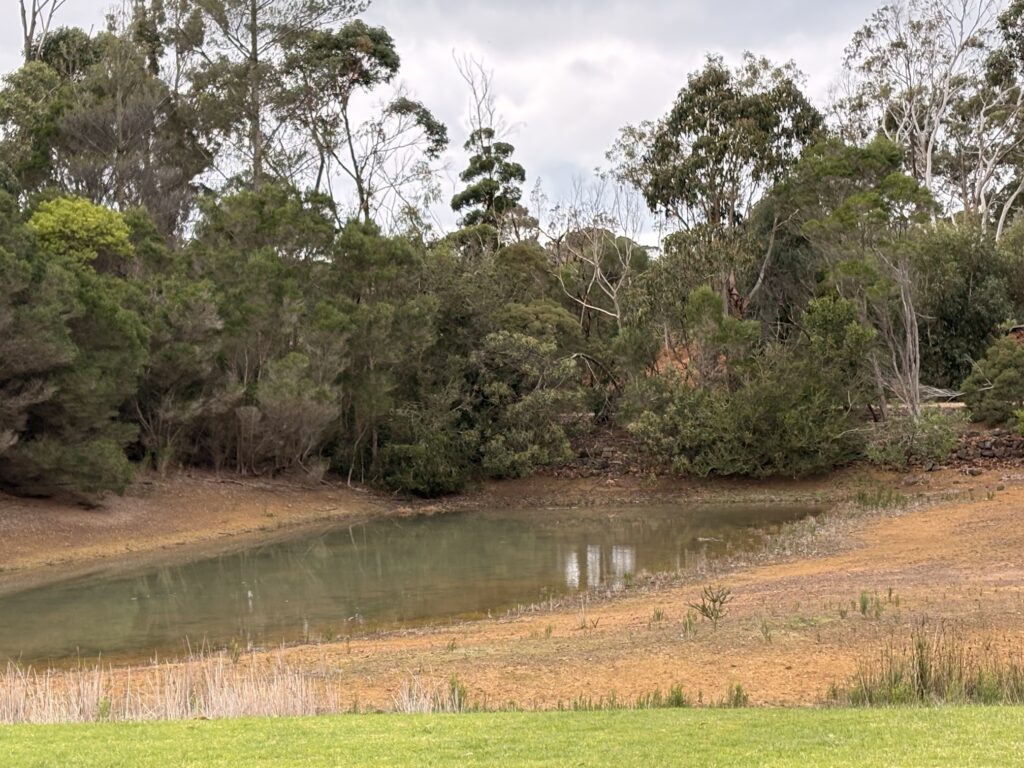
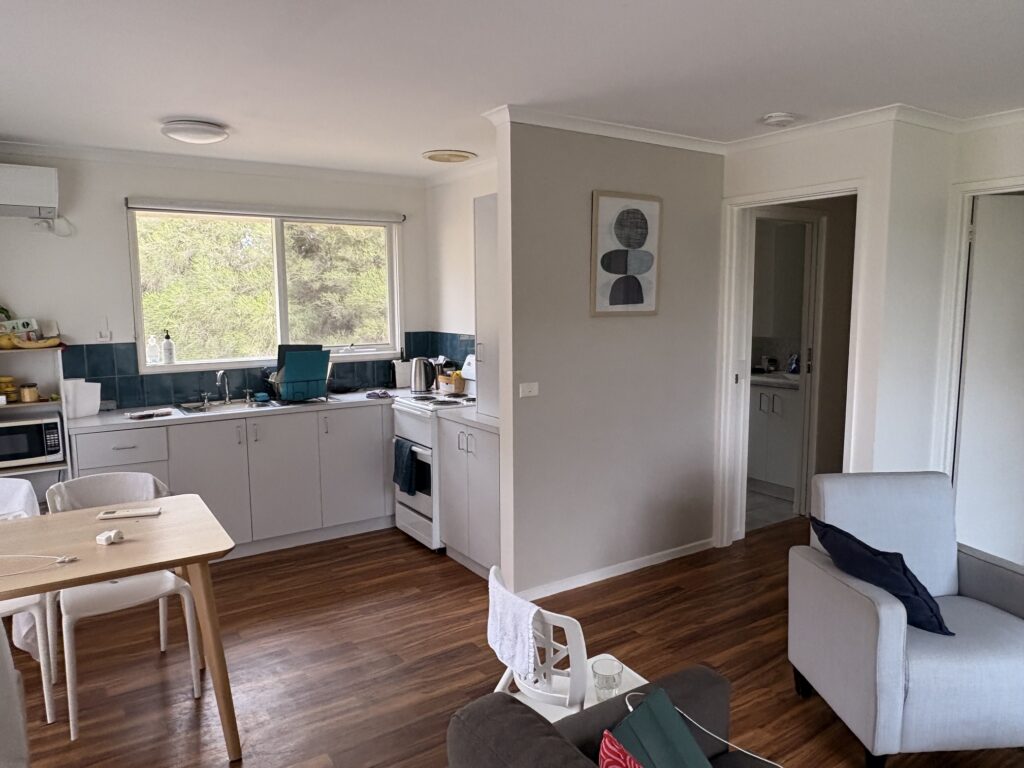
Then a short hop down to the coast to arrive at https://www.bellsbeachcottages.com.au/, inland from the beach and halfway between Torquay and Anglesea. Perfect. I took a quick inventory and noted the very well-equipped kitchen, the inviting wood fire, the peaceful views of the dam and bush out of all the windows: this would do nicely. Best of all, there was not a sound of traffic to be heard.
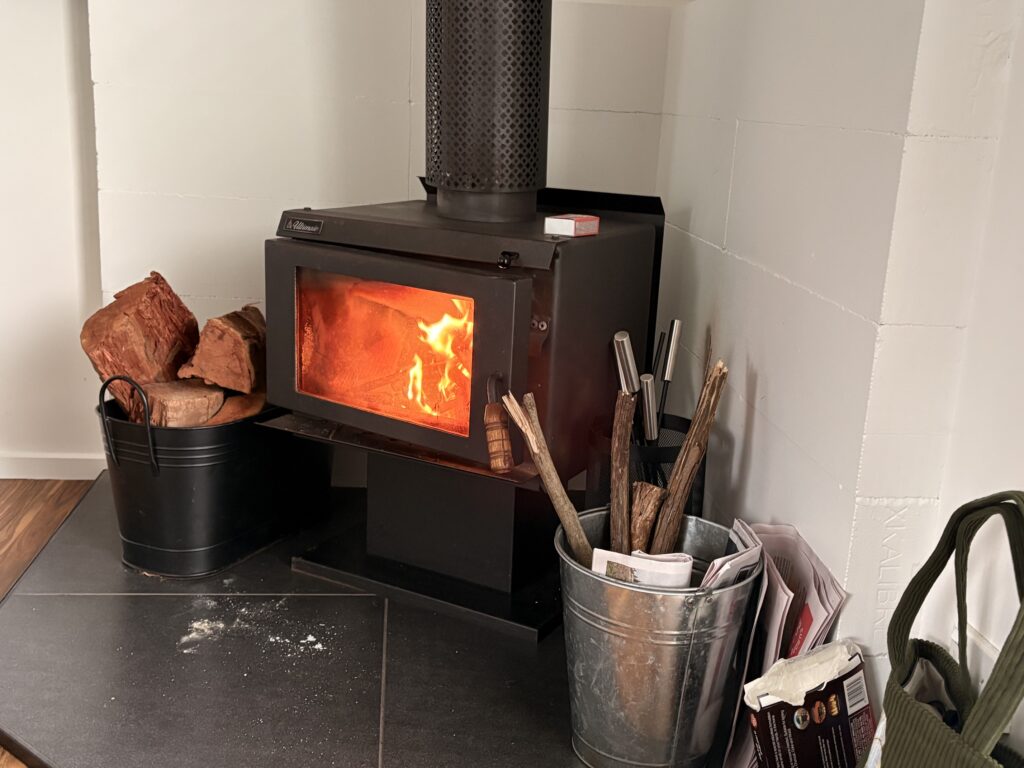
With a cosy fire (lots of big and small wood provided), World Cup football and the Tour de France, a pile of books and my knitting, I could feel myself unwinding immediately. Even sitting in front of a fire and doing nothing feels like a legitimate activity on a holiday! Years of full diaries and long to-do lists are hard to shake off, but I am working on it.
We slept right through the first night, which I hadn’t been doing lately, and took the morning in slow gear. One of our very old friends lives near Geelong. As he is not well now, we took the chance while were over that side to catch up.
Over home-made soup and warm bread we had a rich time of memories and shared many funny stories! We were at college in together and both ended up as missionaries in Indonesia and had so many adventures. Our children were little expatriate mates in a world of Indonesians (they will always be third culture kids), and our friend introduced us to food we might never have tried and places we might never have explored! These memories are unique and we treasure them. We felt a tinge of sadness as we left after several hours of catching up – he is frail with Parkinsons, and at our age we are well aware of time slipping by.
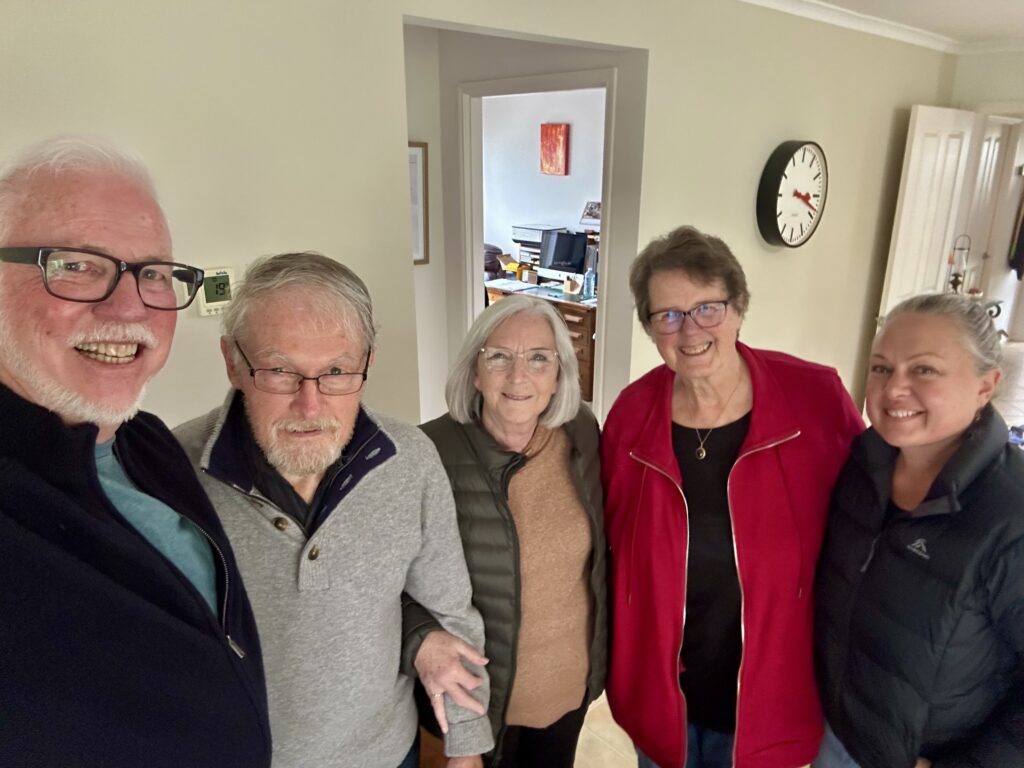
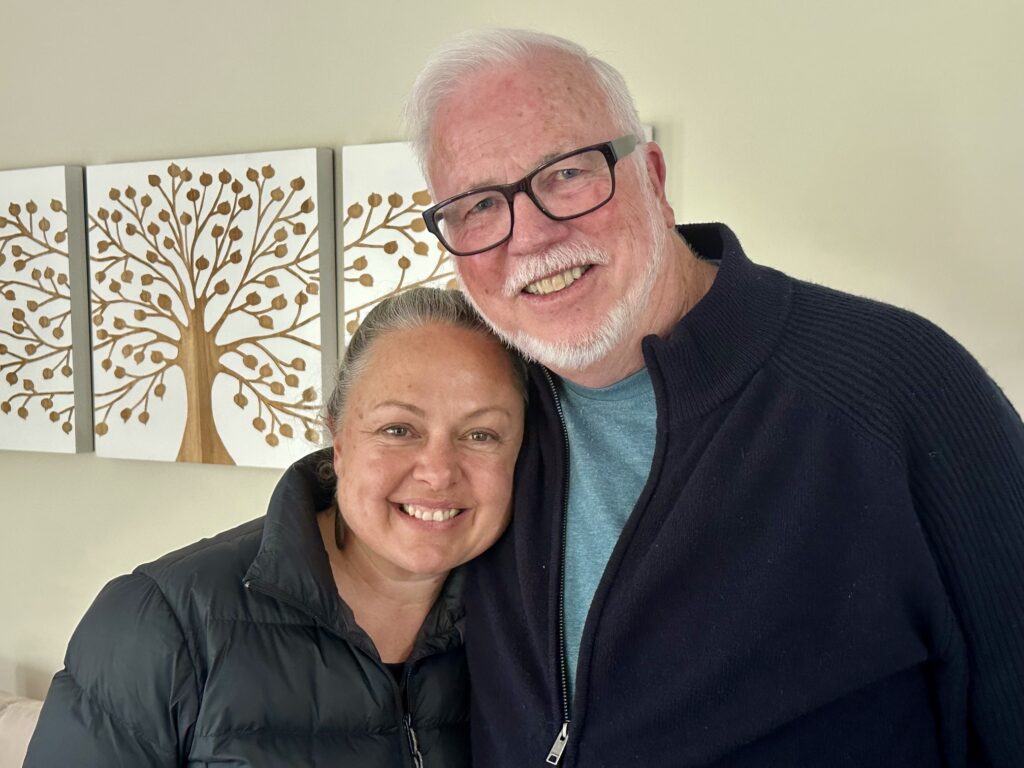
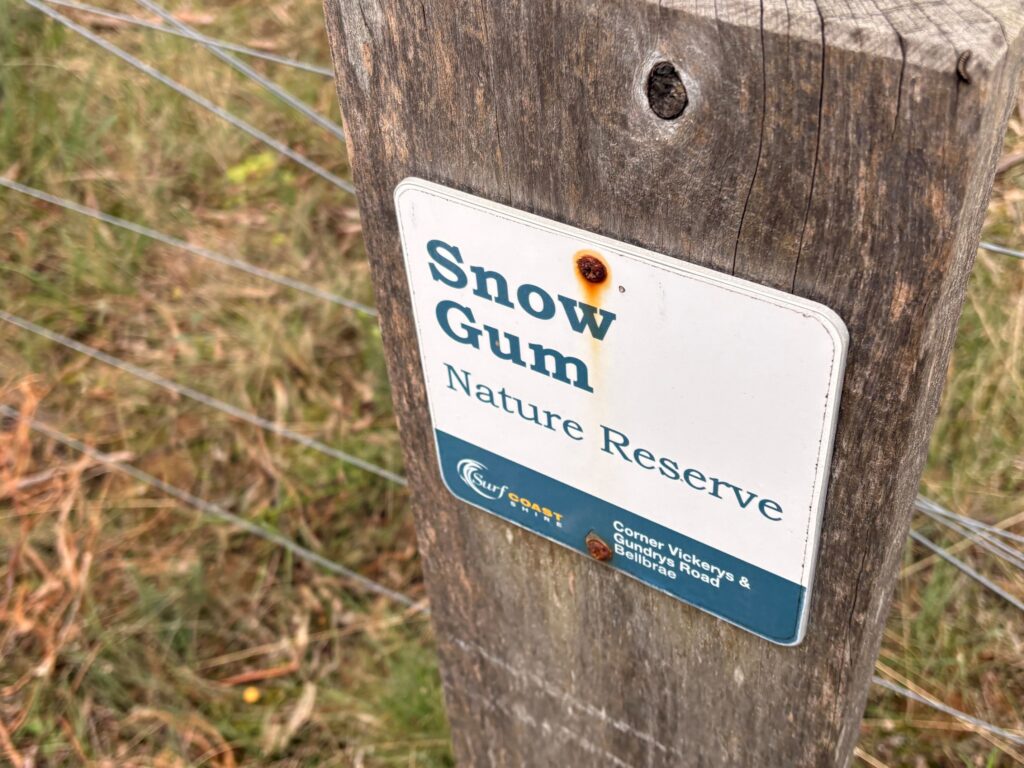
Now it was time to explore. In an amazing coincidence, after we had randomly booked Bell’s Beach, Peter discovered that there was a connection with his current artistic obsession with snow gums. Yes, that’s right! Snow gums normally grow, not surprisingly, above the snow line at around 700m, but they also survive at lower altitudes, including right near the coast. So we headed for Snow Gum Reserve in nearby Bellbrae and were delighted to find a fenced-off conservation area of beautiful old growth snow gums! We wandered and photographed the twisted limbs and peeling coloured bark and began to feel drawn in to the magic of the bush. I am looking at trees with new eyes these days.
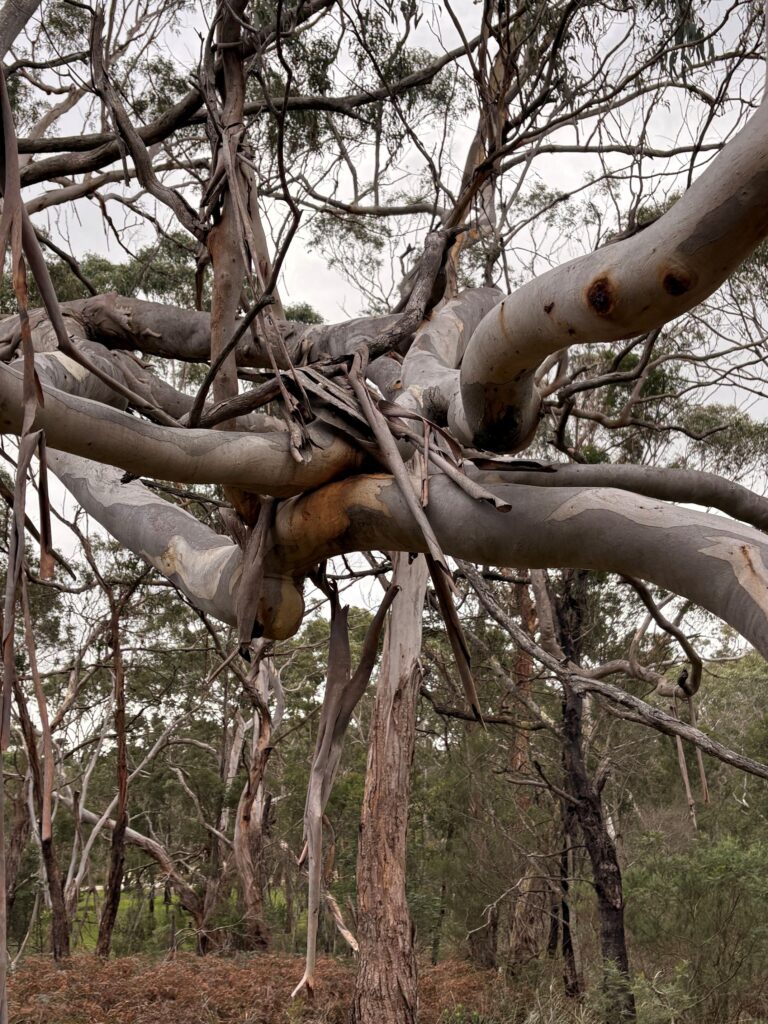
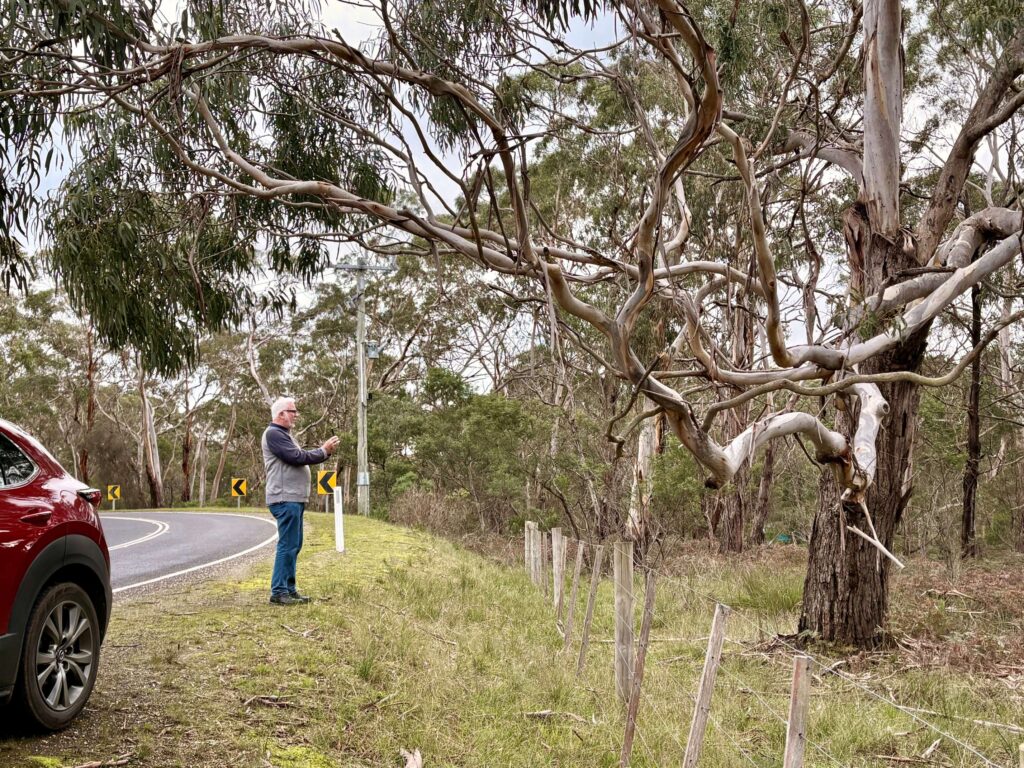
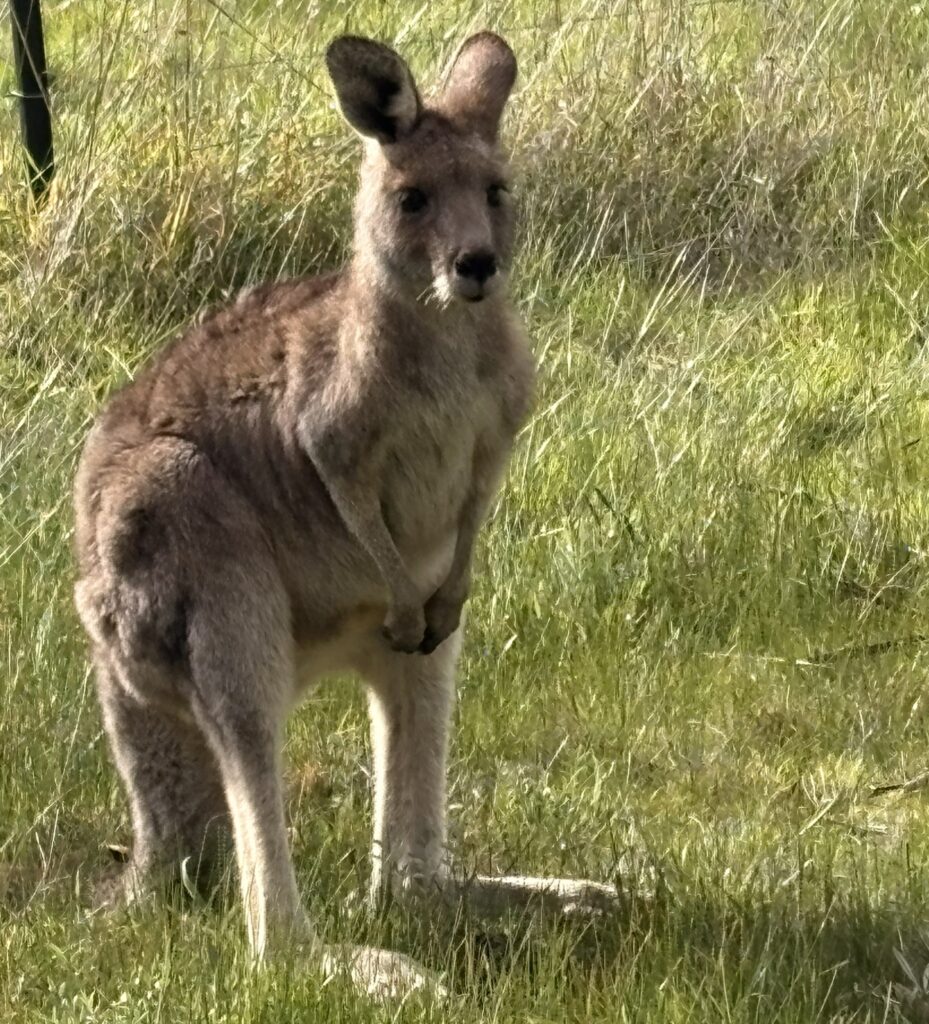
Peter is currently painting abstract snow gums for a possible next exhibition, and we have driven to other stands to see them. He has hiked in the high country near Marysville, but found that most of the snow gums there have not recovered from the fires. He is keen to see, feel and photograph the trees personally rather than paint from other people’s photos. Looks like we have a few more expeditions coming up! We had a close encounter with a thoughtful kangaroo that wondered why we were there.
My next choice of activity was to do the Koorie Cultural Walk near Pt Addis. Descriptions said it is a ‘gentle 1 km loop in the ironbark forest with interpretive signs and information about the indigenous history in the area.’ Just right, I thought. Coming off the back of a rough month of poor heart health, that seemed a do-able walk that would stretch me enough and raise my heart rate. I laced up my shoes and took my trusty walking stick. I didn’t realise that it would neither be 1km nor gentle!

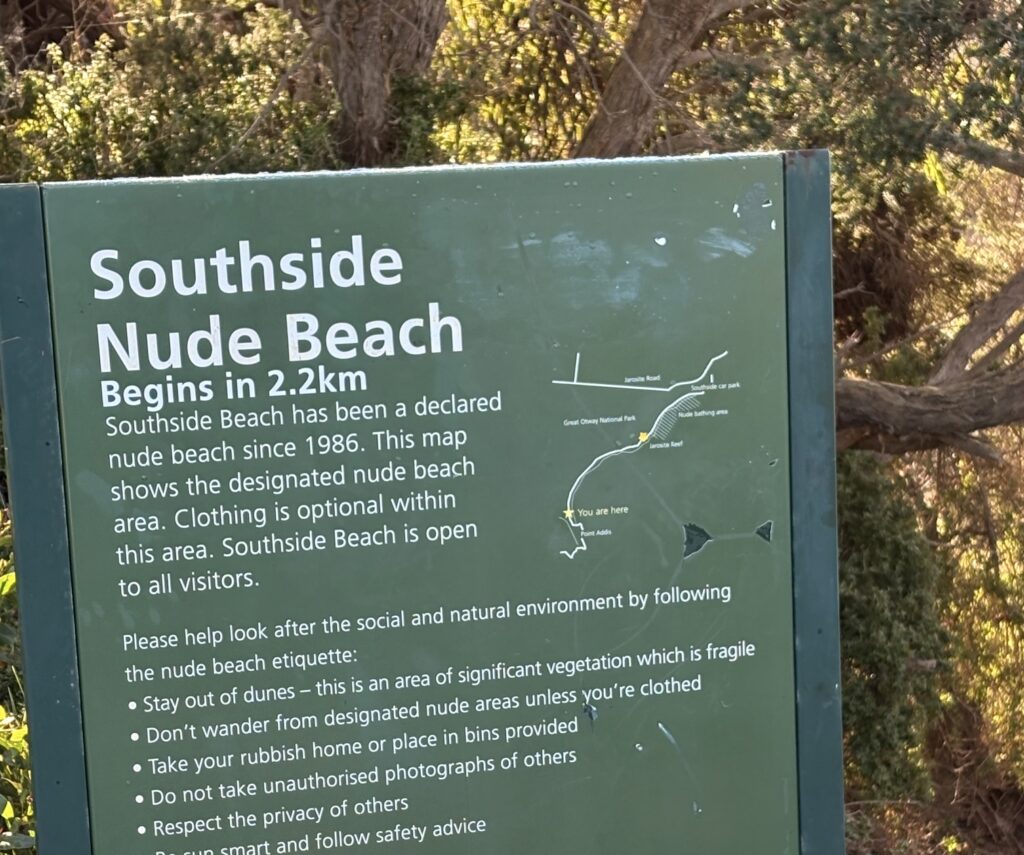
That was the start of three attempts to find said trail! Google maps actually took us to the far end of the trail, we discovered later, but there was no sign to indicate. It is a small part of the ironbark trail, but lack of signage makes it very confusing. All we did find was a sign to a beach where clothing is an optional’. Thankfully for everyone it was too cold to contemplate! We did a scenic drive and went back to our fireside haven.
The next day we tried again. This time we found a carpark signed ‘Cultural Trail’ and a path, but it was actually the Nature Circuit. May as well try it! The path looked good, but it went down, down, down until I baulked at having to go back up, up and up. So I pushed myself back up the hill while Peter completed the circuit.
What a sensational habitat! Ironbark trees are tall and tough with deeply ridged dark bark. Indigenous groups today use the ironbark as a symbol of strength and resilience (like the Ironbark Aboriginal Corporation in Darwin) and I can see why. The whole reserve is a typical sclerophyll dry forest, which has an open canopy of ironbarks and string messmates.
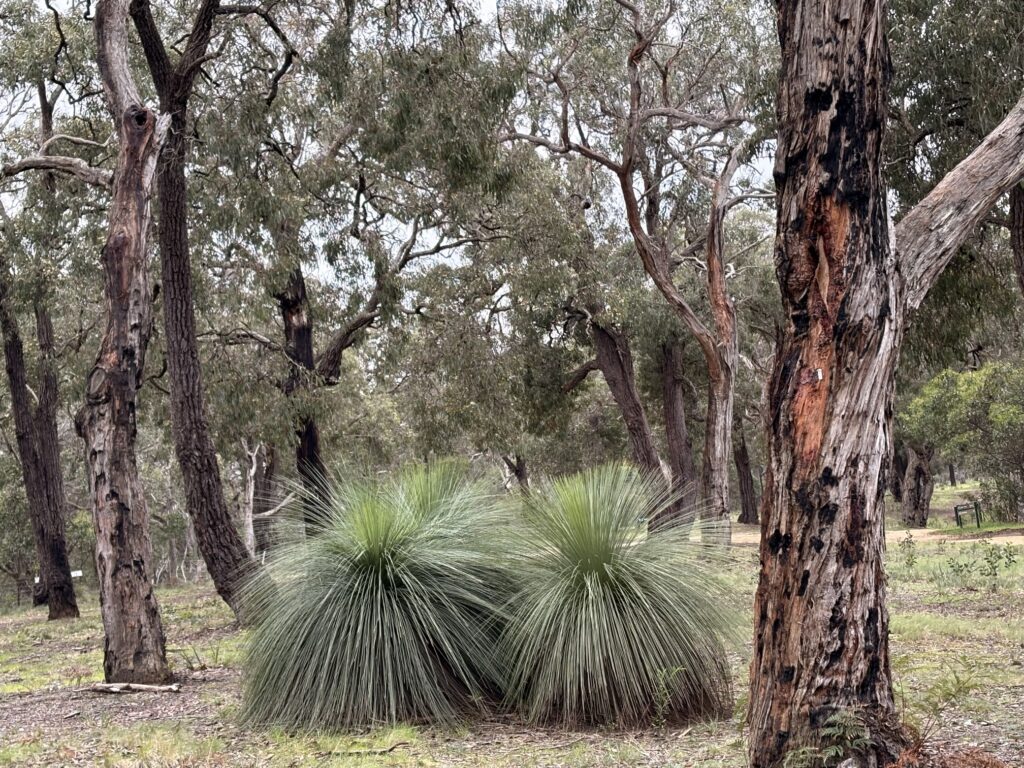
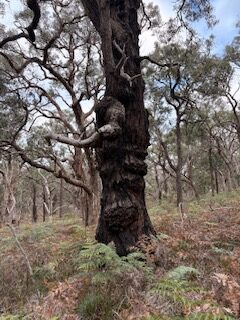
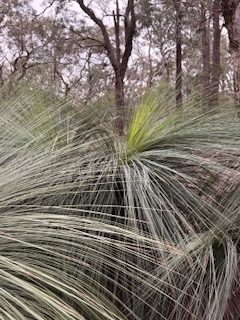
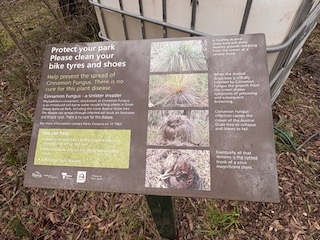
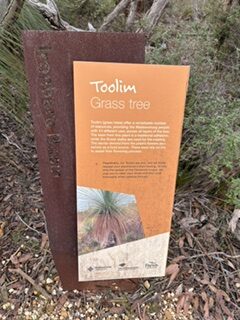
The lower flora featured the most spectacular Austral grass trees I have ever seen in their natural habitat; they wave sensuously in the breeze and make the whole forest move. Sadly, they are threatened by Cinnamon fungus, and the entrance to the park asks for bikes and boots to be cleaned on the way in. Virulent in Australia, it causes root rot and die back.
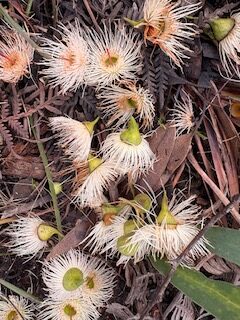
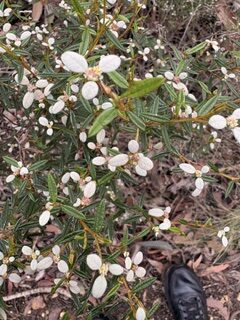
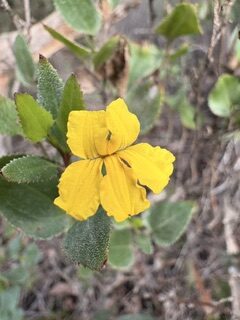
Pomaderris is not familiar to me, but they are mixed in with bracken, wattle, mat rush, a few wildflowers and moss. The only flowers we saw were mainly hop goodenias. In spring, there would be nodding greenhoods and flat peas as well. The ironbarks flower in summer, and there were fallen flowers on the path, which seemed late in mid winter.
This habitat shelters all sorts of fauna, but we saw none. As I walked back alone, I was treated to a cacophony of kookaburras cackling from above. Maybe they were laughing at my slow progress up the unrelenting hill. But I made it and Peter emerged from the other end at the same time. On the last stretch, a young couple ran up the steep path and overtook me, pausing to ask if I was OK. That was kind of them, but it made me feel old! I was actually relaxed and renewed, and full of wonder at how a wander in the bush can be such a powerful and positive experience.
I am thinking of writing a creative piece for the Nature Conservancy essay competition on the ironbark basin. It requires being able evoke a sense of place, which I really felt. Two years ago I wrote on the mangrove stands in our home town, and having researched them so much, I felt as if I owned them. I think that is the ‘sense’ part of ‘place’. The unique makeup of any habitat is always worth a close look.
So we had a third try to find the cultural trail. Guided by the instructions of a local hiker who told us exactly where the track started, we found it. It had no sign and we had to guess at the first fork. It was, again, all steeply downhill, with huge rocks every few metres to control the water flow. It was in no way a ‘gentle walk’! I scrambled, slipped, rolled and lurched, trusting my stick and hanging on tightly to Peter’s backpack. Eventually it would have been further to go back uphill, than to finish the walk, so we pressed on.
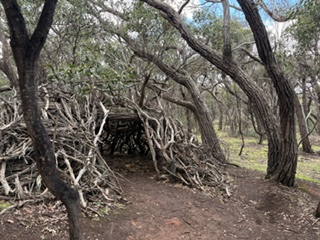
It was very peaceful in the dappled sunlight and we only saw a couple of other people. There were three information signs, not much information, and a couple of bark huts built by unknown people, presumably not thousands of years ago…
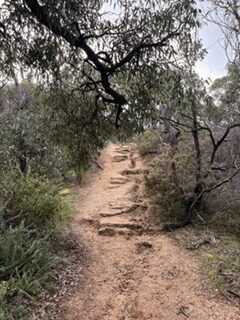
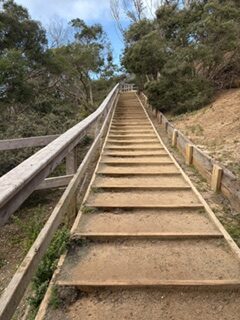
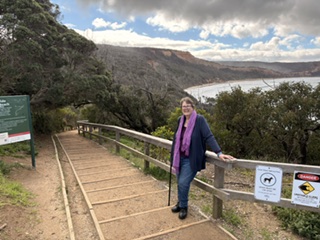
With stunning ocean views on our left, we made it to the Pt Addis lookout end, where a flight of about 100 steps took us back up to the lookout. We were glad not to have done the walk in reverse, uphill all the way, but it did mean that someone had to walk back up the road and retrieve our car. I am married to a very good man! All I know is that a few weeks ago I couldn’t walk out to the backyard due to bad heart rhythms, so I had an immense sense of achievement and restored health.
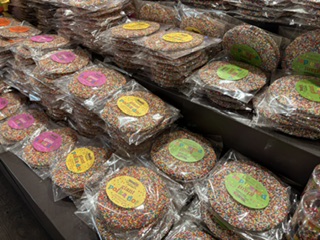
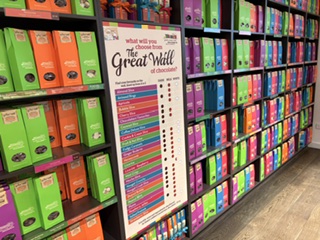
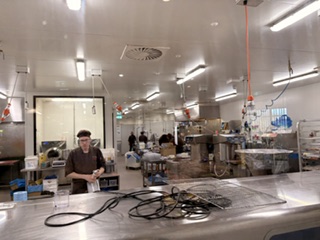
Every time we left the cottage we seemed to pass the sign to the Great Ocean Road Chocolaterie, https://www.gorci.com.au/ so we finally succumbed, on the pretence of taking some gifts home. It was huge and quite overwhelming. Walls and stands of packaged chocolate treats and a viewing spot to where the sweets are made. We filled our shopping basket quickly and made our escape. The dark chocolate rocky road looked the most tempting – and a bit of a metaphor for our lives lately! No photo because it has all gone…
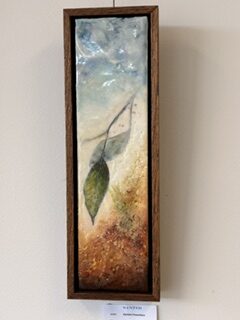
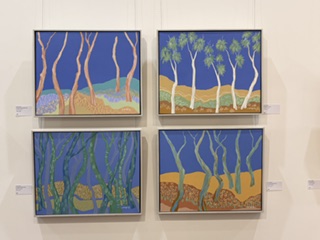
We always find galleries, and went to one in both Anglesea https://www.surfcoast.vic.gov.au/Experience/Arts-culture-and-heritage/Anglesea-Art-Space and Torquay https://www.hoopgallery.com.au/. The former had some beautiful nature work, and surprisingly, is subsidised by the council. No such thing in our shire; that is a huge encouragement to local artists. The Torquay space, Hoop, was very spacious and had an exhibition of indigenous art, which was very pleasing. She even had some snow gums! The style was somewhere between indigenous, naive and decorative in muted tones.
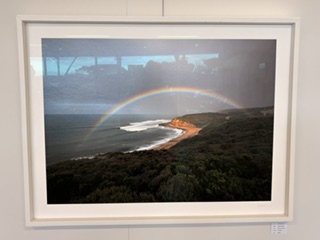
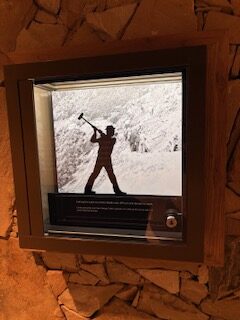
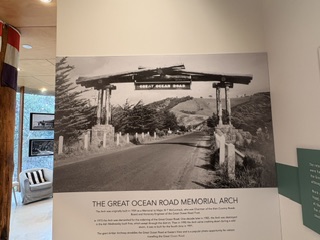
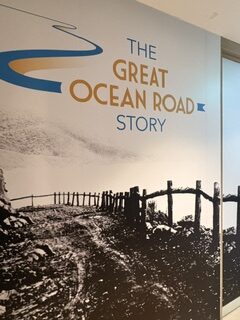
One great discovery was a display in the Lorne Information Centre that showed the history and human side of the building of the Great Ocean Road by 2500 returned soldiers. For some, it was therapeutic (imagine digging that road with shovels and picks!) while for others, the blasting triggered their PTSD (unacknowledged and undiagnosed, of course) from the war.
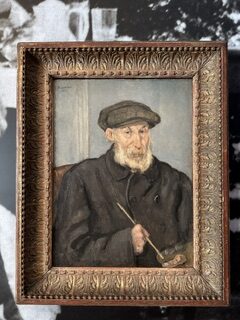
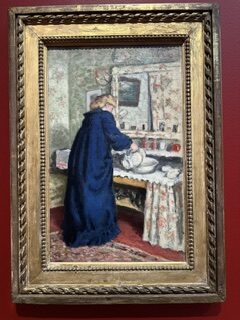
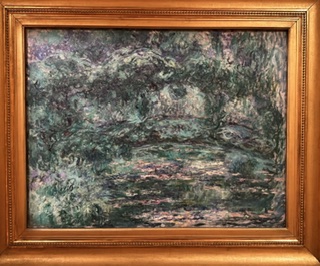
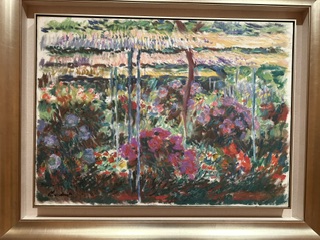
It was time to go home, but very fortunately, our route was taking us through Geelong, where there is an Impressionist exhibition. What could we do but stop and find the Geelong Gallery? Having seen so many Impressionist painting on our trips to Europe, we didn’t expect many surprises. But surprised we were, as there were painters even Peter has never heard of, and paintings of famous impressionists we have not seen.
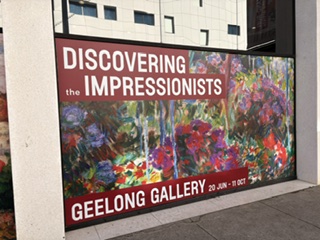
The gallery is lovely, with walls in strong jewel colours; it is big enough to be satisfying but small enough not to be exhausting. The paintings have plenty of space, and wandering around corners takes you into new areas. So the art dealer, Paul Durand-Ruel, supported artists who were actually the second wave, building on the classic painters and experimenting. Some of them returned to the early impressionist style later.
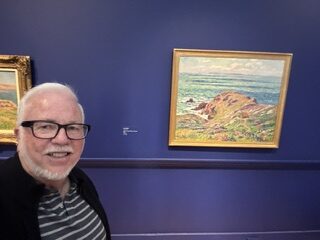
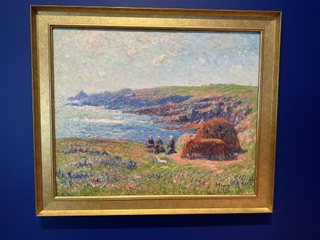
Monet, Renoir and Pissaro were featured, including a lovely green toned abstract of Monet’s famous bridge. But the second generation of painters long overshadowed by their illustrious predecessors featured: Albert André, Georges d’Espagnat, Gustave Loiseau, Maxime Maufra and Henry Moret. Their works still capture the light, and feature very intimate paintings of women at their toilette, and women in gardens. The sea and nature still feature and there is a great sense of decorative but strong work. I loved it all and had too many favourites!
What a way to end our little holiday! We had a delicious lunch right across the road in the Geelong Arts Centre cafe, and vowed to return and explore more of Victoria’s second city. Somehow each trip shows us how much more there is to see of God’s creation and human creativity. Can’t wait for the next road trip. (Hint: The Archibald exhibition is in Shepparton in October…)

Well done Jeanette. I enjoyed reading this very much!